Pakistan hospital fire inquiry exposes critical safety failures as 8 officials face suspension
Investigation into deadly blaze at Pakistan Institute of Medical Sciences reveals nursery lacked fire alarms and sprinklers, while supervisory staff were absent when flames killed 14 newborns in approximately two minutes.
Pakistan hospital fire inquiry exposes critical safety failures as 8 officials face suspension
Eight senior officials at one of Pakistan's premier public hospitals have been suspended and now face criminal proceedings following an inquiry that exposed catastrophic safety failures behind a fire that killed 14 newborn babies.
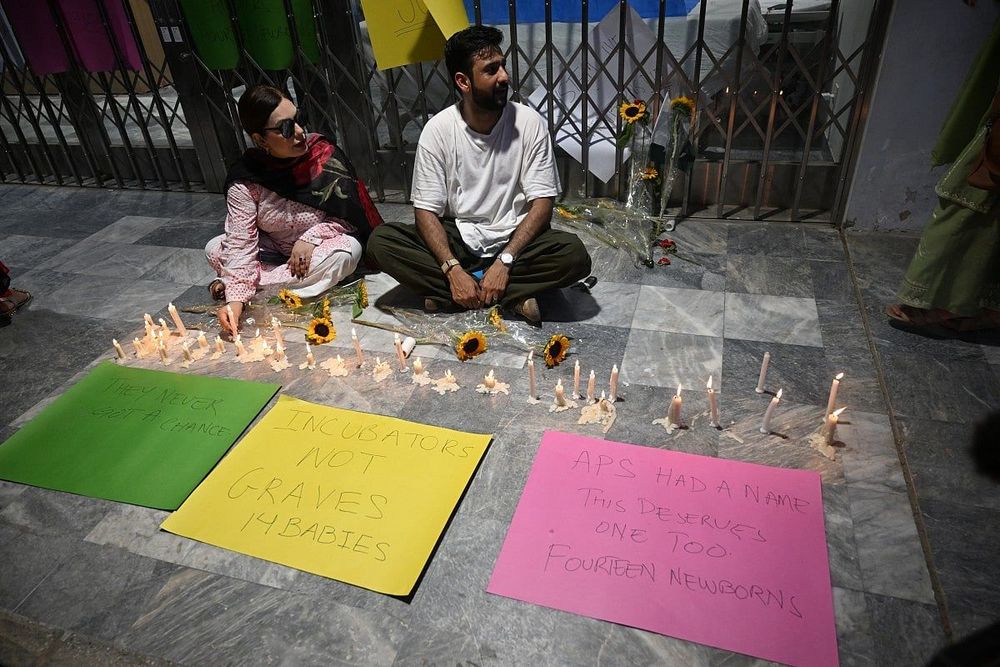
The investigation into Wednesday's tragedy at the Pakistan Institute of Medical Sciences (PIMS) in Islamabad revealed that the neonatal ward had no fire alarm system, no sprinklers, and lacked adequate emergency protocols when flames consumed the nursery in approximately two minutes. Only one of 15 infants survived.
The fire reportedly began around 6:45 AM when an air conditioning compressor exploded inside the nursery. Oxygen cylinders and pipelines in the ward caused the blaze to spread with devastating speed, according to rescue officials.
Systemic failures uncovered
Prime Minister Shehbaz Sharif ordered the immediate suspensions after receiving the interim inquiry report, vowing that those responsible for criminal negligence would receive no leniency. The suspended officials include PIMS Executive Director Professor Dr Imran Sikandar, joint executive directors, the neonatal department head, and security personnel.
PIMS, a 592-bed hospital established in 1985, serves as a national referral facility for northern Pakistan, including Rawalpindi, Islamabad, Azad Jammu and Kashmir, and parts of Punjab province. The institution comprises three semi-autonomous hospitals, with the fire occurring at the 125-bed Maternal & Child Health Care Centre specializing in obstetrics and gynecology.
Investigators found the hospital had experienced another fire at its nursing hostel just one month earlier in July, yet serious safety improvements were not implemented afterward. Of the hospital's 13 standard operating procedures, only two subsections addressed fires or emergencies. No dedicated officer was responsible for fire emergencies, with those duties assigned as additional responsibilities to an assistant director.
Critical delays in response
The inquiry documented troubling gaps in the emergency response. Supervisory staff were not on duty when the fire began. Two nurses, a female security guard, and a house officer were present in the ward at the time. Emergency services were not contacted until six minutes after the fire started, and first responders arrived 15 minutes after receiving the call.
According to CCTV footage analyzed in the inquiry, nurse Razia Noreen entered the burning nursery and emerged just eight seconds later carrying a baby—the sole survivor. Noreen will receive the Sitara-i-Khidmat, a state honor recognizing distinguished public service, along with approximately $36,000.
Around two minutes of CCTV footage from the nursery was shown during Saturday's high-level meeting reviewing the tragedy, though the video has not been publicly released.
Widespread safety deficiencies
The disaster at PIMS reflects broader systemic problems across Pakistan's healthcare infrastructure. A 2023-2024 patient safety assessment of six tertiary hospitals in Peshawar found overall compliance with WHO patient safety criteria at just 28.1 percent, with public sector hospitals achieving 35.6 percent compliance compared to 22.3 percent at private institutions.
Building fires are common in Pakistan, where safety regulations and building codes are routinely ignored or poorly enforced. In January 2026, at least 65 people died when a massive fire swept through a crowded shopping complex in Karachi. Previous deadly hospital fires include incidents at Lahore's Services Hospital in June 2012, the National Institute of Child Health in Karachi in January 2020, and the nursery of Sahiwal Teaching Hospital in June 2024.
Investigators also found violations of relevant World Health Organization rules concerning neonatal wards at PIMS, adding to concerns about the deteriorating condition of the facility and wider administrative failures.
Government response
Sharif had earlier dismissed Health Secretary Aslam Ghauri, the Health Ministry's most senior civil servant, following the blaze. Dr Muhammad Salman, chief executive of Pakistan's National Institutes of Health, will take over as acting executive director of PIMS.
The government has announced compensation of 5 million Pakistani rupees (approximately $18,000) for each family that lost a child. Departmental and criminal proceedings have been ordered against those found responsible, including action against the private security company and its officials.
Punjab province has ordered an immediate review of fire-safety systems, firefighting equipment, and emergency-response facilities at hospitals across Pakistan's most populous region.
The prime minister said exemplary punishment should be imposed to ensure no mother would again lose her child due to another person's criminal negligence. For the 14 families mourning their newborns, the inquiry's findings have laid bare a simple but devastating truth: the nursery entrusted with their babies' lives lacked the most basic fire safety equipment.