OWWA clarifies OFW Lounge rules: 24-hour eligibility, 6-hour stay limit
The Overseas Workers Welfare Administration has resolved confusion over its NAIA lounge policy, explaining that while OFWs with connecting flights within 24 hours qualify for lounge access, actual stays are capped at six hours due to limited seating capacity.
OWWA clarifies OFW Lounge rules: 24-hour eligibility, 6-hour stay limit
The Overseas Workers Welfare Administration has issued a clarification aimed at ending confusion among returning Filipino migrant workers over lounge access rules at Ninoy Aquino International Airport.
Under the policy, an overseas Filipino worker arriving on an international flight may use the OFW Lounge if the passenger has a confirmed domestic connecting flight within 24 hours of actual international arrival. However, that does not mean the worker can remain inside the lounge for the entire 24-hour period.
The stay is limited to six hours per visit, OWWA said, with possible extensions for special circumstances and subject to available space.
Eligibility versus occupancy
The key distinction is straightforward: the 24-hour window determines whether an arriving OFW qualifies to use the lounge, while the six-hour limit governs how long that worker can actually remain inside.
An OFW who lands at NAIA at 8 a.m. and has a confirmed domestic connection at 6 p.m. qualifies because the connecting flight falls within 24 hours of international arrival. But that passenger cannot occupy a lounge seat from 8 a.m. until 6 p.m.
OWWA emphasized that the 24-hour period is counted from the worker's actual international arrival and serves as the basis for determining eligibility to use the lounge. The rule does not allow an OFW to stay inside the facility continuously for 24 hours.
Capacity constraints drive the policy
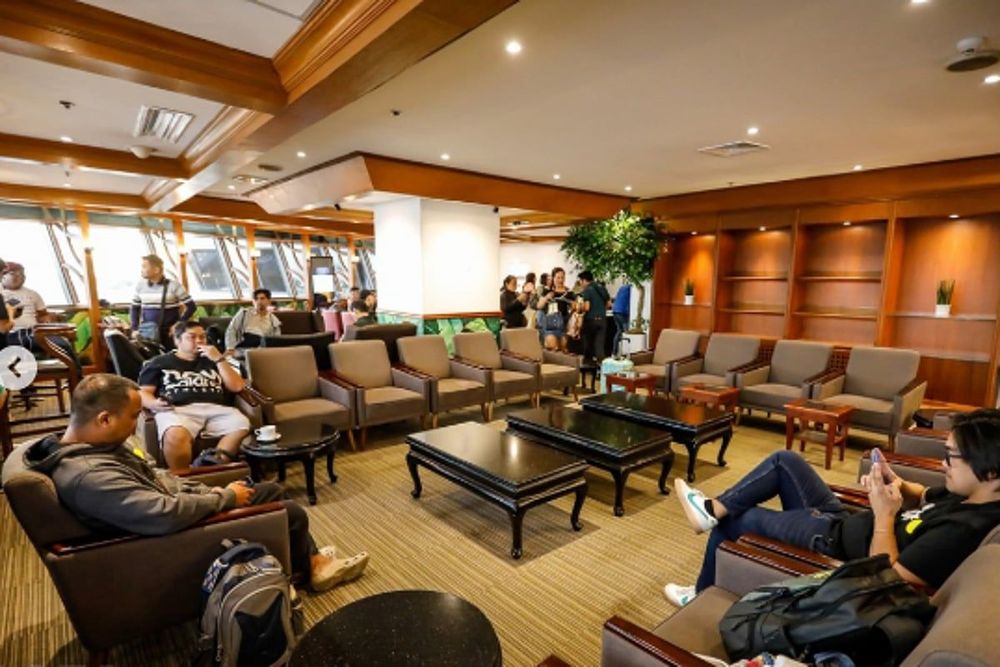
The six-hour limit reflects a fundamental capacity problem. OWWA says between 4,000 and 6,000 OFWs depart from NAIA every day, while the OFW Lounge has seating for only 216 people at Terminal 3 and 140 at Terminal 1.
NAIA handled 52.02 million passengers in 2025, the highest ever recorded, representing nearly a 4 percent increase from 50.1 million passengers in 2024. The airport's current passenger capacity is 35 million annually, though the airport operator plans to expand this to 62 million annually under a ₱170.6 billion concession agreement with the San Miguel Corp.-led New NAIA Infrastructure Corp.
The lounge is intended to provide a temporary holding and welfare space for OFWs, not function as a hotel or extended waiting room. OWWA says the six-hour limit ensures that passengers with approaching flights have a reasonable chance of getting a seat.
The agency operates a real-time occupancy and monitoring system, allowing staff to track available seats. Displays outside the lounges show the number of available slots. If the facility is full, passengers may be placed in a queue and told about expected waiting times and available assistance.
Extensions possible for special cases
The six-hour rule is not completely inflexible. OWWA said extensions may be considered depending on capacity and verified special circumstances, including medical needs, senior-citizen status and disability.
An OFW should not assume that an extension is automatic. It depends on the circumstances and available space. The approach reflects a balancing act: OWWA has to provide a safe and comfortable facility while preventing a relatively small number of seats from being occupied for excessively long periods.
A government welfare service, not a commercial lounge
The OFW lounges are part of the government's support system for Filipino migrant workers. OWWA documents describe the NAIA Terminal 1 facility as a waiting and holding area where OFWs can rest, obtain refreshments, charge devices and access government services. The agency says the lounge is free to OFWs, regardless of OWWA membership status.
OWWA, an attached agency of the Department of Migrant Workers, currently lists OFW lounges at NAIA Terminals 1 and 3, as well as Mactan-Cebu International Airport. A fourth lounge at Clark International Airport Terminal 2 is scheduled to officially open on September 16, 2026.
The number of Overseas Filipino Workers was estimated at 2.19 million in 2024, up 1.5 percent from 2.16 million in 2023, according to the Philippine Statistics Authority. Asia remained the primary destination for OFWs in 2024, accounting for 74.5 percent of total departures, followed by Europe at 10.6 percent, North and South America at 9.2 percent, Australia at 4.4 percent, and Africa at 1.3 percent.
OWWA received a ₱4.2 billion allocation for 2026, a 26 percent increase from the previous year's ₱3.4 billion budget, with ₱1.286 billion specifically allocated for emergency repatriation and ₱942 million for the Alagang OWWA program. The agency operates 31 overseas posts in 27 countries and maintains regional presence in seventeen regions within the Philippines.
Practical implications for workers with connections
The clarification is particularly relevant to workers returning to provinces after arriving from the Middle East, Asia, Europe and other international destinations. A passenger may have completed a long international journey but still face several hours before a connecting domestic flight to Cebu, Davao, Iloilo, Cagayan de Oro, Bohol or another Philippine destination.
For such travelers, the lounge can be an important place to rest, eat, charge phones and access assistance. But the limited seating means an OFW with a long connection may have to leave the lounge after six hours even if the domestic flight is still several hours away.
The practical advice is therefore straightforward: check your actual international arrival time, confirm your domestic flight, and treat the six hours as a maximum normal lounge stay, not as part of the 24-hour eligibility window.
OWWA maintains a 24/7 operations center for OFW concerns and assistance. Its official contact information lists OWWA Hotline 1348.