Philippines' AI hub ambitions hinge on workforce skills, power infrastructure and jobs transition
Manila's bid to become a Southeast Asian AI hub through the Pax Silica initiative faces critical tests in developing technical talent, expanding power generation capacity and managing labour market disruption as automation reshapes employment.
Coalition launched in Washington, Philippines joins in April
The Philippines is positioning itself to become an artificial intelligence hub in Southeast Asia, with tens of billions of dollars in potential investment riding on a US-led coalition known as Pax Silica. Yet business leaders warn the country must urgently address skills gaps, power shortages and labour market disruption if it hopes to capitalize on the opportunity.
Donald Lim, president of the Management Association of the Philippines, said the country remains far behind AI leaders such as the United States, India and China, but sees the Pax Silica project as a critical test of whether Manila can attract advanced technology investment and move beyond low-value assembly work.
Pax Silica was formally launched on December 12, 2025, at the inaugural Pax Silica Summit in Washington, D.C., with initial signatories including the United States, Japan, South Korea, Singapore, the Netherlands, the United Kingdom, Israel, the United Arab Emirates and Australia. The coalition aims to secure supply chains for semiconductors, AI infrastructure and critical minerals.
The Philippines joined in April 2026, becoming roughly the 13th member and one of only two Southeast Asian countries in the coalition alongside Singapore. Trade Undersecretary Ceferino Rodolfo signed the declaration on April 17.
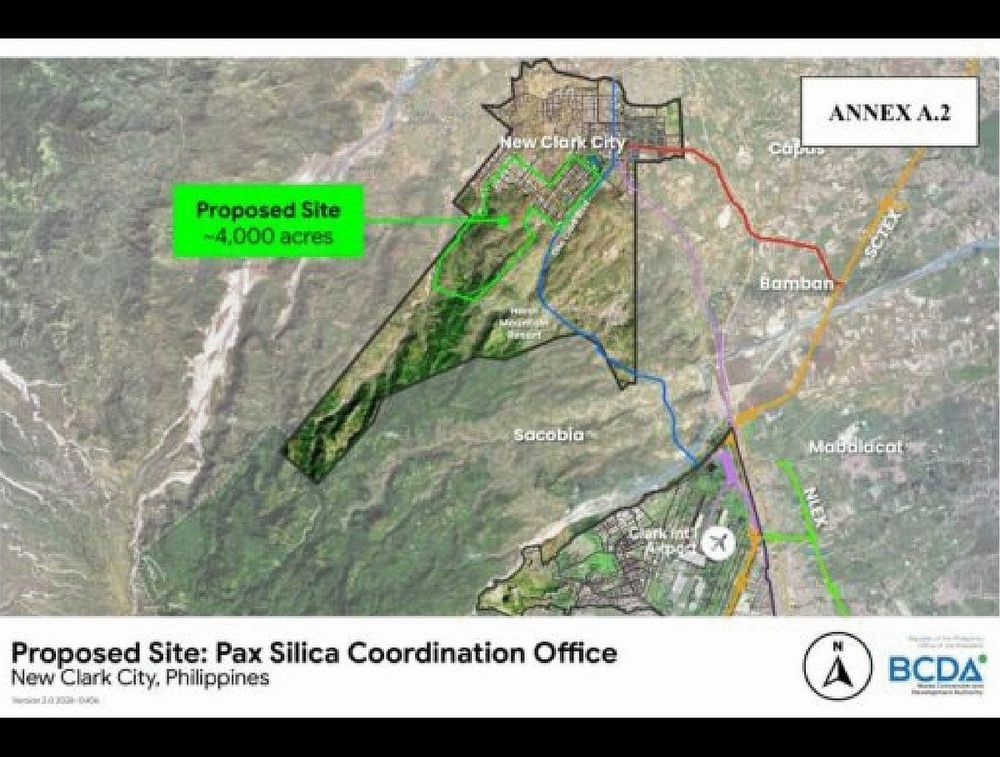
Under the plan, a 1,619-hectare AI-focused industrial hub is proposed for New Clark City in Tarlac, a 9,450-hectare planned community on the site of a former US military base in the municipalities of Bamban and Capas. The broader New Clark City project is designed to accommodate up to 1.2 million people and create 800,000 jobs.
The Pax Silica hub itself is projected to attract $40 billion to $70 billion in investments over 30 years and generate 130,000 to 190,000 direct jobs. BCDA President Joshua Bingcang has said hyperscale data centres will not be part of the site, though smaller facilities to support semiconductor firms may be built.
Regional competition and economic stakes
The push comes as the Philippines seeks to catch up with neighbours that have made deeper inroads into AI-driven growth. Singapore upgraded its 2026 GDP growth forecast to 4.5 to 5.5 percent in August, up from a previous forecast of 2 to 4 percent, driven by stronger-than-expected global AI investment and AI-related electronics exports. The city-state's economy grew 6.1 percent year-on-year in the first half of 2026, with manufacturing expanding 12.2 percent on AI-related electronics production, particularly semiconductors and related components for global AI infrastructure.
By contrast, Philippine growth projections for 2026 remain in the 3.5 to 5.5 percent range, according to the Development Budget Coordination Committee. Lim warned that the Philippines is often omitted from lists of ASEAN countries targeted for AI investment, and stressed that missing the current wave could leave the country behind as 17 to 20 nations compete in the same initiative.
The Philippines does have an existing electronics manufacturing base to build upon. Semiconductor and electronics exports reached approximately $46 billion in 2022, easing to $41.9 billion in 2023 and $39.1 billion in 2024, with semiconductors as the dominant component underscoring the sector's central role in the country's trade performance.
Power generation emerges as critical constraint
Infrastructure constraints pose a major challenge. The Philippines had roughly 500 megawatts of installed data centre capacity across 28 facilities in early 2026, compared with Singapore's approximately 1.4 gigawatts. The government is targeting 1.5 gigawatts by 2027 and 18 gigawatts over the next decade.
Wholesale electricity prices surged 58 percent across Luzon, Visayas and Mindanao in March 2026. Historically, the Philippines has had among the highest electricity prices in Southeast Asia. While recent wholesale tariffs declined from approximately $0.10 per kilowatt-hour in 2024 to $0.074 per kilowatt-hour in early 2025, prices still challenge the economics of energy-intensive AI and data centre developments.
Jobs displacement and the labour transition
A central question is how AI will reshape the Philippine labour market, where services account for 63.8 percent of exports and many workers are employed in roles vulnerable to automation, from caregiving to driving.
Lim acknowledged that robots and AI systems are increasingly handling tasks once done by nurses, security personnel and search-and-rescue teams, but argued that efficiency gains could expand business and create new jobs even as some roles disappear.
He cited estimates that while up to 1.9 million jobs could be displaced by automation, around 2 million new positions may be created as industries expand and move up the intelligence ladder. The challenge, he said, is to avoid training graduates merely to compete with machines on routine tasks, and instead emphasize critical thinking, creativity and foundational skills in English and mathematics.
Agriculture and education applications
In agriculture, Lim said AI can help farmers make better decisions on planting, irrigation and pest control by analysing soil, water and harvest data, even if they do not operate drones or advanced equipment themselves. He noted that many smallholders still lack basic connectivity, so the precondition for AI — internet and digital infrastructure — must be addressed first.
On education, Lim argued that schools were designed for an era of scarce information, whereas today information is ubiquitous. He said the focus should shift from teaching AI tools per se to building critical thinking, self-understanding and communication skills, with AI introduced more substantially at the high school level when students begin coding and complex prompting. He agreed with policies in some developed countries that restrict mobile phones and laptops in elementary classrooms, calling them a major distraction.
Critical minerals and the value chain challenge
The Philippines is a major producer of nickel and other critical minerals essential to electric vehicle batteries and stainless steel. In 2023, the country exported over $1 billion worth of nickel ores and concentrates to China, accounting for over 90 percent of Philippine nickel ore exports. The Philippines was the world's largest exporter of nickel ores and concentrates to China that year.
Most Philippine nickel operations directly ship nickel laterites to China as direct-shipping ore without further processing to increase value. In 2022, 96.5 percent of the country's nickel ore exports went to China, valued at $2.67 billion. Much of it is processed in China and re-exported as finished products such as EV batteries and stainless steel, leaving the Philippines in a low-value position on the supply chain.
Business community backs initiative with guardrails
Despite objections from some groups, the Management Association of the Philippines has expressed full support for Pax Silica, subject to certain guardrails. Lim welcomed public debate and opposition as a way to surface risks and implementation challenges, but said the initiative still makes sense on paper because of the potential for knowledge transfer, job creation and broader economic activity around the hub.
He framed Pax Silica as one of the country's biggest opportunities to bring in investment at a time when the national budget faces a large deficit and domestic business alone cannot generate the needed revenue.
We cannot afford to be picky, Lim said, urging the Philippines to welcome investors while putting in place rules to protect national interests.
Near-term economic outlook remains subdued
On the near-term economic outlook, Lim said he is not optimistic that the Philippines can fully recover from a slow first half of 2026 without a significant increase in government spending and construction activity. He warned of a potential crunch for businesses and support sectors if public outlays remain constrained, and said he expects inflation to rise and growth to stall somewhat before a possible rebound in the following year.
Lim's message to the private sector is to act normal and avoid banking on a sudden sales recovery, while preparing for a tighter 2026 and looking ahead to an election-year boost in 2027.