UAE economy posts 3% growth as non-oil sectors drive structural transformation
The UAE's first-quarter GDP rose 3% to Dh485 billion, with non-oil activities expanding 4.8% and now accounting for nearly four-fifths of national output, marking significant progress in economic diversification.
UAE economy posts 3% growth as non-oil sectors drive structural transformation
The UAE economy expanded by 3% in the first quarter of 2026, pushing real gross domestic product to Dh485 billion from Dh470.9 billion a year earlier. More significantly, non-oil GDP grew by 4.8%, outpacing overall growth and raising its share of national output from 78% to 79.4% within a year.
The shift reflects the results of sustained government investment across investment, trade, infrastructure, technology and business development. Nearly four-fifths of the economy now originates from activities outside oil extraction, widening the productive base and creating new channels for investment, trade and employment.
Multiple sectors contribute to expansion
Financial and insurance activities made the largest contribution to non-oil growth during the quarter. Construction, healthcare, communications, professional services, real estate and trade also expanded, reducing the relative weight of oil in national output.
Mohammad bin Abdullah Al Gergawi, Minister of Cabinet Affairs, said the 79.4% non-oil contribution resulted from integrated government policies working towards a common objective.
The results of the first quarter of 2026 reflect the ability of the UAE's government work system to translate the wise leadership's strategic vision into tangible economic results that serve people and the future.
The performance advances the "We the UAE 2031" objective of doubling the national economy to Dh3 trillion by 2031. The vision, structured around four pillars—Forward Society, Forward Economy, Forward Diplomacy and Forward Ecosystem—also targets raising non-oil exports to Dh800 billion and total foreign trade to Dh4 trillion by that date.
Record trade reinforces momentum
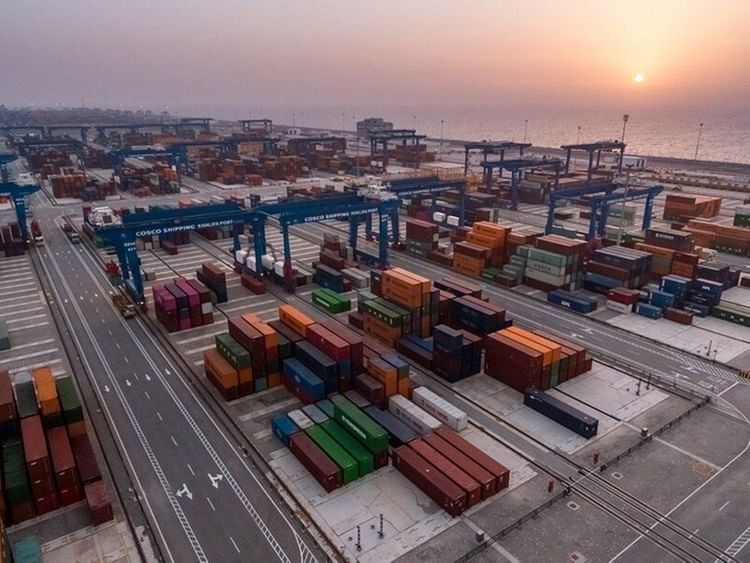
First-half trade results published in July provide additional evidence of the transformation. The UAE's non-oil foreign trade reached a record Dh1.937 trillion during the first six months of 2026, rising 13.1% from Dh1.728 trillion a year earlier.
Non-oil exports grew faster still, climbing 23.9% to a record Dh452.8 billion. Their share of total foreign trade increased from 21.3% to 23.4%, meaning domestically produced exports accounted for a larger proportion of trade.
His Highness Sheikh Mohammed bin Rashid Al Maktoum, Vice-President and Prime Minister of the UAE and Ruler of Dubai, described the figures as reflecting
the strength of our economy, the effectiveness of our development choices and the world's confidence in the UAE.
Trade agreements expand market access
The Comprehensive Economic Partnership Agreements programme supports trade diversification by widening access to overseas markets. The UAE had concluded 38 CEPAs by July 2026, up from 32 in January, according to the Ministry of Foreign Affairs. Trade with countries covered by the agreements reached Dh304.3 billion in the first half.
The UAE-India CEPA, which came into effect on May 1, 2022, was the country's first such agreement. Non-oil trade with India reached approximately USD 37.6 billion in the first half of 2025, demonstrating the programme's capacity to generate measurable trade growth.
CEPAs reduce or eliminate customs duties, simplify procedures and encourage private investment, deepening the UAE's integration into global supply chains and connecting domestic diversification with international demand.
Infrastructure investments support next phase
The UAE continued investing in infrastructure needed to support future economic growth. Etihad Rail began introductory passenger services between Abu Dhabi and Fujairah on June 30, less than five years after the National Railway Program was announced as part of the "Fifty Projects" in 2021. The passenger service is operated by Etihad Rail Passenger Services, a joint venture between Etihad Rail and international transport operator Keolis.
Dubai announced the Dh34 billion Metro Gold Line in April, with the 42-kilometre route scheduled for completion in 2032. The line will expand the Dubai Metro network from 120 kilometres to 162 kilometres—a 35% increase—and raise the total number of stations from 67 to 85. Beyond 2040, the line is expected to serve 465,000 daily passengers and remove more than 40 million car journeys annually, reducing congestion on the existing Red Line between BurJuman and ONPASSIVE by 23%.
In July, the UAE began the wider rollout of Jaywan, its national card payment scheme. Operated by Al Etihad Payments, a wholly-owned subsidiary of the Central Bank of the UAE, Jaywan was inaugurated by Sheikh Mansour bin Zayed Al Nahyan on July 20, 2026. The cards use co-badging with international networks including Discover, Mastercard, Visa and UnionPay, allowing domestic UAE transactions to clear through the national UAESWITCH system while international transactions route through partner networks. Domestic processing strengthens control over financial infrastructure, supports lower electronic-payment costs and reduces reliance on international networks for local transactions.
DP World and the Fujairah Ports Authority also reached an agreement in principle in July to develop the Al Rugaylat and Dibba terminals, expanding future container and general cargo capacity in Fujairah.
The central result remains the increase in non-oil GDP and its rising share of the economy. Combined with record first-half non-oil trade, it provides measurable evidence that diversification is changing the structure of UAE growth.