Trump threatens strike on Iran's Pickaxe Mountain nuclear facility 'pretty soon'
US President Donald Trump has escalated pressure on Tehran by threatening to strike Iran's heavily-fortified Pickaxe Mountain tunnel complex in central Iran, as multiple B-1 Lancer bombers reportedly depart UK bases and aerial refueling tankers launch from Romania.
Trump threatens strike on Iran's Pickaxe Mountain nuclear facility 'pretty soon'
US President Donald Trump warned that the United States could strike Iran's heavily-fortified Pickaxe Mountain tunnel complex "pretty soon," escalating tensions over Tehran's nuclear programme as multiple US strategic bombers reportedly departed from bases in the United Kingdom and Romania early Wednesday.
"We'll see what happens. It could be pretty soon," Trump told reporters when asked whether the United States would target the underground facility. He later vowed the area will get hit "probably pretty soon" and "very heavily."
Multiple US Air Force B-1 Lancer strategic bombers departed the UK shortly after Trump's direct threat, according to reports. UK Prime Minister Burnham has approved the use of British bases for US strikes on Iran, according to Bloomberg. Boeing KC-135 Stratotanker aerial refueling aircraft also launched from Romania, consistent with refueling operations for bombers headed toward the Middle East, though the exact purpose of the deployment remains unconfirmed.
Underground fortress in the Zagros Mountains
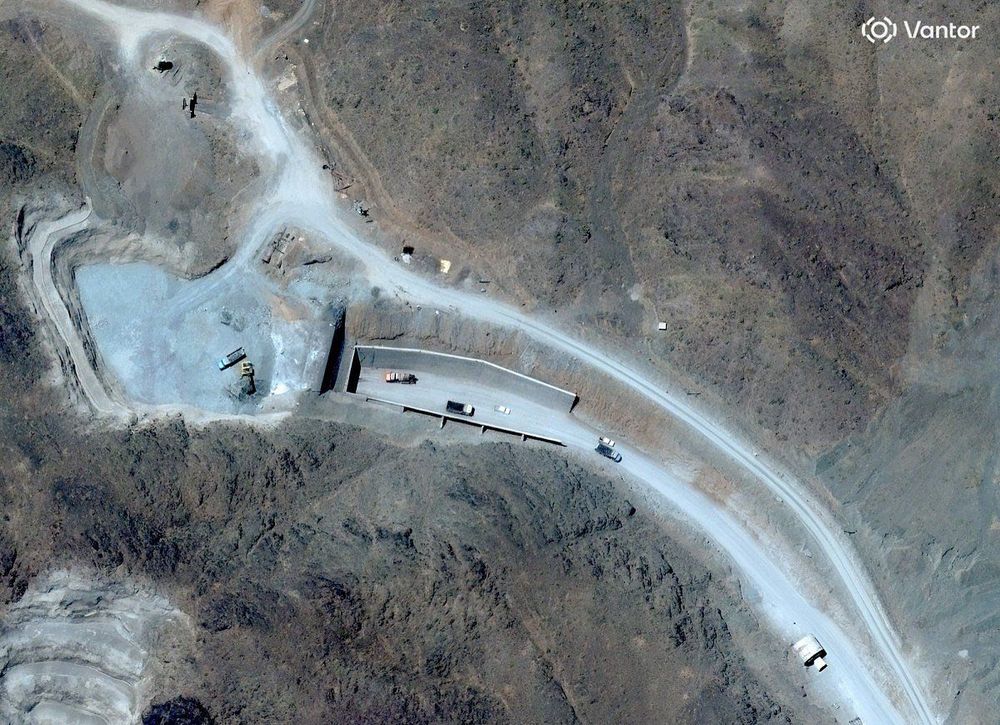
The Pickaxe Mountain facility, known locally as Kuh-e Kolang Gaz La, sits in the Zagros mountain range approximately 220 kilometers south of Tehran and about 8 kilometers south of Iran's main Natanz nuclear enrichment complex. The peak rises about 1,600 meters above sea level in a mountain range that stretches approximately 1,500 kilometers across western Iran, historically serving as a natural defensive barrier against invasions from Mesopotamia and the west.
Construction at Pickaxe Mountain began in autumn 2020, shortly after a July 2, 2020 sabotage operation attributed to Israel destroyed an advanced centrifuge production plant at Natanz, prompting Iran to announce plans for a more modern underground facility. The facility is buried at least 100 meters underground and features four tunnel entrances that have been hardened with layers of concrete and earth. In 2025, Iran constructed a double security perimeter around the entire mountain.
The Wall Street Journal reported that Iran moved thousands of centrifuges into the tunnels under Pickaxe Mountain. Iran initially declared the facility to the International Atomic Energy Agency in 2020 as a future site for centrifuge assembly, but IAEA inspectors have never been granted access to the complex, and the exact purpose of the site remains officially unknown.
Military challenge and weapons capability
Military analysts say any attack on the facility would require advanced bunker-busting munitions capable of penetrating hundreds of feet of rock before detonation. The GBU-57 Massive Ordnance Penetrator, weighing 30,000 pounds with a 6,000-pound warhead, can penetrate up to 200 feet of reinforced concrete and can only be carried by the B-2 Spirit stealth bomber, with each aircraft capable of carrying two bombs.
The GBU-57 was first used in combat on June 22, 2025, when B-2 Spirit bombers deployed between 12 and 14 of the weapons during US strikes on Iranian nuclear installations at Fordow, Natanz, and Isfahan in Operation Midnight Hammer.
Nuclear programme and verification crisis
As of May 2025, Iran possessed approximately 440.9 kilograms of uranium enriched to 60% U-235, according to IAEA estimates. However, Iran has denied IAEA access to verify its enriched uranium stockpile for nearly one year following the June 2025 strikes, creating a near-total loss of monitoring of Iranian nuclear sites.
The main Natanz complex adjacent to Pickaxe Mountain began secret construction in 2001 and was exposed to the international community in August 2002 by a dissident group. Designed to eventually accommodate 50,000 centrifuges, Natanz became Iran's primary uranium enrichment site but has been repeatedly targeted in sabotage and cyberattacks. The 2010 Stuxnet cyberattack attributed to the US and Israel destroyed approximately 1,000 centrifuges at Natanz, with additional incidents occurring in 2020 and 2021.
Regional implications
US and allied intelligence agencies continue to monitor construction and activity around the Pickaxe Mountain tunnel network, which is considered one of Iran's most hardened underground facilities. Tehran has repeatedly insisted its nuclear program is peaceful and has warned that any additional US military action would trigger a strong response from Iranian armed forces and regional proxy groups.
Trump did not elaborate on what intelligence prompted the renewed warning or whether military planning was underway. His remarks come after months of heightened confrontation between Washington and Tehran following US military operations against Iranian nuclear infrastructure.
If carried out, a strike on the Pickaxe Mountain complex would represent another major escalation in the confrontation between the United States and Iran, raising concerns about broader regional instability and the potential impact on global energy markets. Washington maintains military assets across the Middle East and continues maritime security operations aimed at protecting commercial shipping and deterring Iranian attacks.