Hong Kong court to rule on Tiananmen vigil organisers charged under national security law
Two former leaders of the Hong Kong Alliance face verdict Friday on inciting subversion charges under China's national security law for organising annual Tiananmen Square commemorations that drew up to 200,000 people.
Hong Kong court to rule on Tiananmen vigil organisers charged under national security law
A Hong Kong court is set to deliver its verdict Friday in the case of two organisers of the city's annual Tiananmen Square vigil, who are charged under a Beijing-imposed national security law that has effectively silenced Hong Kong's pro-democracy movement.
Lee Cheuk-yan and Chow Hang-tung, former leaders of the Hong Kong Alliance in Support of Patriotic Democratic Movements of China, face charges of inciting subversion and could be sentenced to up to 10 years in prison if convicted. The activists pleaded not guilty when their trial opened in January and are expected to appear in court Friday for the ruling.
Three decades of commemoration
The Hong Kong Alliance was founded on May 21, 1989, during a million-person march in support of the pro-democracy protests taking place in Beijing's Tiananmen Square. For three decades, the organisation held the only large-scale public commemoration in China of the 1989 crackdown, which killed hundreds and possibly thousands when government troops and tanks were sent to suppress student-led demonstrations in the capital.
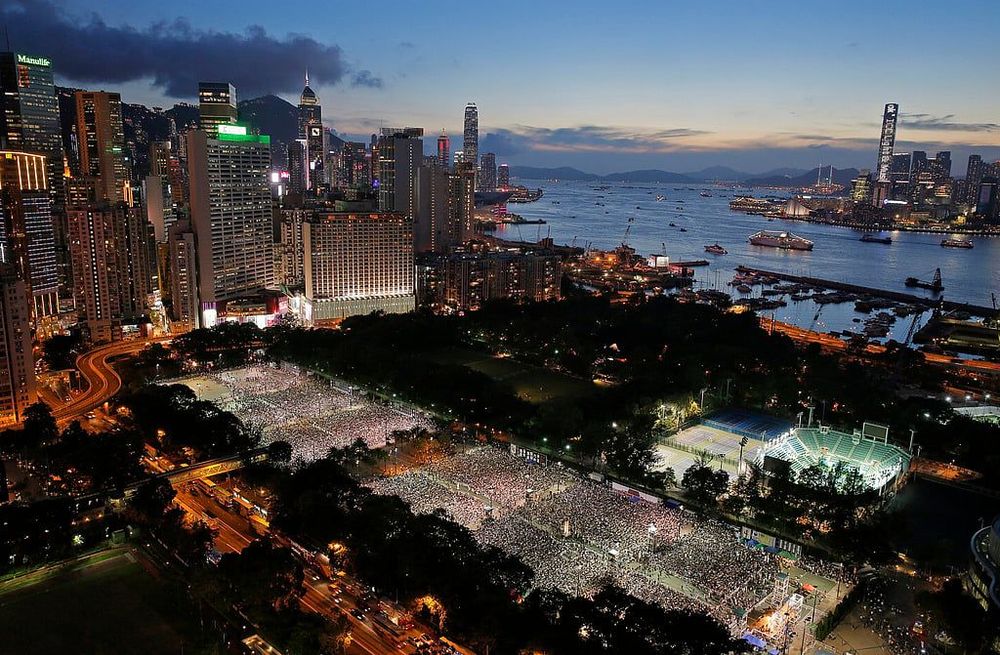
The annual Victoria Park vigil typically attracted between 100,000 to 200,000 attendees, making it the largest public commemoration of the Tiananmen crackdown on Chinese soil. The event became an unofficial taboo in mainland China, but Hong Kong's vigil kept the memory alive until authorities banned the gathering in 2020, citing coronavirus pandemic health risks.
Weeks after the ban, Beijing imposed the national security law that was later used to prosecute the vigil organisers. The Hong Kong Alliance voted to disband in September 2021, the same month Lee and Chow were charged.
Prominent activists face trial
Lee Cheuk-yan, a former General Secretary of the Hong Kong Confederation of Trade Unions and Legislative Council member from 1995 to 2016, served as the Alliance's chairman. Chow Hang-tung, a barrister and human rights lawyer, served as vice chair. She has been detained since September 2021 and was previously sentenced to 22 months in jail for convictions related to inciting and participating in the June 4 vigils in 2020 and 2021.
Their co-defendant Albert Ho, who led the Alliance from December 2014 to December 2019 between Lee's two terms as chairman, entered a guilty plea earlier. His sentencing is pending, with guilty pleas typically resulting in reduced sentences.
If convicted by three government-approved judges, Lee and Chow will likely be sentenced at a later date.
Prosecution under security law
Prosecutors argued the defendants incited others to use unlawful means to topple China's fundamental system and central political bodies, including through calls to end one-party rule, which was one of the Alliance's core demands.
The defence denied any intent to overthrow the Communist Party's leadership, arguing the slogan was about promoting democratic governance and urging the party to move away from authoritarian rule. They insisted the Alliance never advocated illegal means.
Chow, defending herself in court, warned that if the court fails to properly assess the reasonable effects of their statements, it risks becoming complicit in tolerating abuses by those in power.
Since the national security law's implementation in June 2020, Hong Kong authorities have arrested 332 people under the legislation, averaging approximately 66 arrests per year. Many other leading activists are now jailed under the law, including pro-democracy media tycoon Jimmy Lai. Dozens of civil society groups have disbanded following the law's introduction.
Symbol of eroding freedoms
The government maintains that all accused have the right to a fair trial and that courts exercise their power independently. However, critics view this case as a litmus test of Hong Kong's civil rights and judicial independence.
Eric Lai, a senior fellow with the Georgetown Center for Asian Law, said the Alliance's existence and the annual vigil were key characteristics of Hong Kong under China's one country, two systems framework, which was designed to preserve the city's autonomy and freedoms for 50 years until 2047 following the 1997 handover from British to Chinese rule.
The charge of inciting subversion has commonly been used in mainland China to criminalize the acts of human rights lawyers, activists and intellectuals, including late Nobel Peace Prize laureate Liu Xiaobo, who was convicted of inciting subversion of state power in 2009 for his role in Charter 08, a manifesto calling for political reforms.
Lai noted that observers can gauge the extent to which Hong Kong's judiciary has converged with mainland China's party-led judicial system through the criminal verdict in this case. The prosecution of the vigil organisers and the disappearance of the commemoration symbolize what many see as the erosion of freedoms Beijing promised to maintain when Hong Kong returned to Chinese sovereignty.