Modi's Independence Day address: Youth-focused vision unveiled in 75-minute speech
Prime Minister Narendra Modi delivered his 13th consecutive Independence Day speech from the Red Fort, announcing major initiatives on AI training, free coaching, sports development and drug prevention while repeatedly addressing India's young citizens.
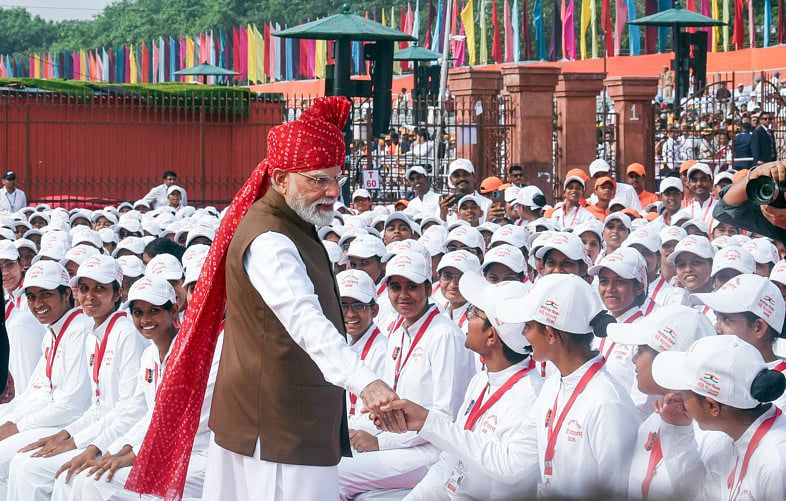
Youth-focused vision unveiled in 75-minute speech
Prime Minister Narendra Modi used his 75-minute Independence Day address to unveil a series of major policy initiatives aimed squarely at India's youth, marking his 13th consecutive speech from the Red Fort and becoming only the second Prime Minister in the country's history to achieve this milestone after Jawaharlal Nehru, who delivered 17 consecutive addresses.
The speech, delivered on August 15, 2026, was notably shorter than his record-breaking 103-minute address in 2025, representing his fourth shortest overall since 2014 and his shortest in four years.
Throughout the address, Modi repeatedly used the phrase "mere pyare deshwasiyon" — my beloved fellow citizens — nearly 40 times. But his most frequent focus was India's young population, with references to youth appearing roughly 50 times using terms including "yuva shakti," "naujawan," and "yuva."
Major youth-centered announcements
Modi announced free online coaching for competitive examinations, addressing what he described as a heavy burden on poor and middle-class families. The coaching industry has become increasingly expensive, particularly for students from smaller towns and rural areas who must bear costs for travel and accommodation on top of institute fees when accessing coaching centers in education hubs.
In a significant expansion of earlier plans, the Prime Minister unveiled an artificial intelligence training initiative targeting one crore (10 million) young people over the next year. This represents a tenfold increase from a programme announced in January 2026 that aimed to train 10 lakh (one million) youth, demonstrating the rapidly scaling ambition of India's AI skills development.
The sports sector received particular attention with the announcement of a nationwide talent hunt for children aged five to 15. The initiative aims to identify promising athletes across India and provide specialized training to develop world-class competitors.
Olympic ambitions take shape
Modi linked the talent development programme to India's sporting ambitions for 2036, stating the country should aim to participate in at least three-fourths of Olympic events. The Indian Olympic Association had submitted a formal Letter of Intent to the International Olympic Committee's Future Host Commission in October 2024, entering India into the continuous dialogue phase for hosting the 2036 Games. Ahmedabad, home to the Narendra Modi Stadium with a capacity of 132,000 making it the world's largest stadium, is the leading candidate host city.
The Prime Minister also confirmed India will host the 2030 Commonwealth Games, the country's first major international multi-sport event since hosting the Commonwealth Games in New Delhi in 2010.
Warning on drug addiction
Alongside the announcements, Modi issued a stern warning about drug addiction, describing it as a major challenge facing young Indians. He urged families to participate in a 100-day nationwide Nasha Mukt Yuva Abhiyan, or drug-free youth campaign, calling the fight against addiction a collective responsibility.
Energy security and civil defence
Beyond youth-focused initiatives, Modi outlined plans to modernize India's civil defence system and emphasized the country's push for energy security. He announced a target of 100 GW of nuclear power by 2047, which would represent more than an 11-fold increase from the current capacity of approximately 8.8 GW operated across 25 nuclear reactors. Achieving this goal would require adding roughly 3.5-4 GW of new capacity annually.
Historic ceremonial milestone
The 2026 Independence Day celebrations at the Red Fort featured a historic first: the full rendition of the national song "Vande Mataram" was sung for the first time since independence, marking 150 years since its composition by Bankim Chandra Chattopadhyay.
Evolving language of address
Analysis of Modi's previous Independence Day speeches reveals shifting patterns in how he addresses the nation. While "deshwasiyon" has remained a staple — used around 50 times in 2025, 30 times in 2024, nearly 15 times in 2023 and over 40 times in 2022 — other forms of address have varied significantly. "Sathiyon" (friends) appeared 10 times this year compared to 35 times last year and nearly 30 in 2024. The year 2023 stood out differently, with "parivaarjan" (family members) becoming his dominant expression at around 50 uses.
In Saturday's address, Modi also employed "desh sevak" (those who serve the nation) and "bhai beheno" (brothers and sisters), demonstrating the linguistic variety he uses to connect with different segments of his audience while maintaining his consistent focus on India's youth as the generation he sees carrying the nation into its future.