Rahul Gandhi calls RSS 'jokers', criticises Modi's foreign policy at Congress plenary
Congress Leader of Opposition attacks Hindu nationalist organisation and questions government's handling of Iran crisis, where Pakistan emerged as key mediator while India remained sidelined.
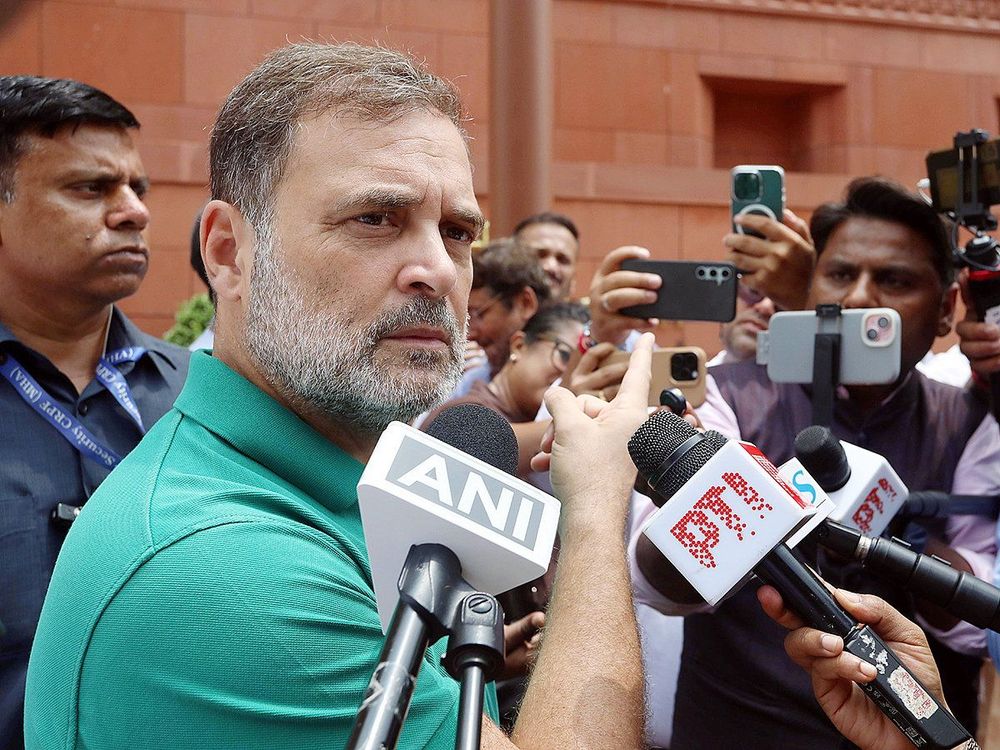
Rahul Gandhi calls RSS a 'bunch of jokers', attacks PM Narendra Modi
Congress Leader of Opposition Rahul Gandhi launched a scathing attack on the Rashtriya Swayamsevak Sangh and Prime Minister Narendra Modi's foreign policy at a plenary session in New Delhi on Thursday, describing the RSS as having no understanding of India's history and philosophy.
Gandhi, who assumed the role of Leader of Opposition in the Lok Sabha on 25 June 2024—the first time in ten years the position has been filled—told party workers there was no reason to fear confronting the RSS.
I can understand if you are fighting the British Empire and suddenly you say, I'm feeling a bit scared. But you're fighting a bunch of jokers. How can you feel scared?
The RSS, founded on 27 September 1925 by Keshav Baliram Hedgewar in Nagpur as a Hindu nationalist volunteer organisation, is widely regarded as the ideological parent of the ruling Bharatiya Janata Party. The organisation, currently led by Sarsanghchalak Mohan Bhagwat since March 2009, was banned by the Indian government in 1948 for alleged involvement in Mahatma Gandhi's assassination, though the ban was revoked in 1949 after the RSS agreed to adopt a constitution.
Gandhi accused the RSS of lacking comprehension of modern India.
Somebody who cannot connect with India as it is today cannot understand India,he said, adding that understanding the country required engaging with contemporary realities rather than focusing solely on events from thousands of years ago.
They talk of things from three thousand years ago but fail to understand the reality of modern India,he said.
Foreign policy under fire
The Congress leader also criticised Modi's approach to international relations, arguing that India's foreign policy should be guided by national interests rather than personal relationships between leaders. Taking aim at what has been termed Modi's "hug diplomacy"—his well-documented practice of embracing foreign leaders—Gandhi said diplomacy could not be reduced to such gestures.
Gandhi specifically cited India's handling of the Iran crisis as evidence of failed foreign policy. Following the 2026 Iran war, which began on 28 February 2026 with joint US-Israeli strikes that resulted in the killing of Iran's Supreme Leader Ayatollah Ali Khamenei, Pakistan mediated a ceasefire between the United States and Iran on 8 April 2026 and subsequently hosted the Islamabad Talks on 11-12 April 2026.
According to analysts, India tilted towards the US-Israeli camp during the conflict but gained little diplomatic leverage, while Pakistan emerged as Washington's preferred backchannel to Tehran—a development viewed as a strategic setback for New Delhi.
Gandhi suggested that had India recognised its own strength and acted with the confidence associated with his grandmother, former Prime Minister Indira Gandhi—who served from 1966-1977 and 1980-1984 and was known for assertive diplomacy, strategic autonomy, and decisive initiatives including the 1971 Bangladesh Liberation War—it could have used its ties with Iran, the US and Russia to increase its influence.
Pakistan became the mediator, while India and Modi-ji simply looked on,he said, accusing the government of damaging India's foreign policy standing.
Gandhi concluded by emphasising that India could only be understood by allowing people to speak freely and by engaging with the country as it exists today, rather than through abstract references to ancient tradition.