Appeals court halts Trump White House ballroom construction, citing need for Congressional approval
A federal appeals court ruled Friday that President Trump's planned White House ballroom requires explicit Congressional consent, upholding a lower court decision and setting up a Supreme Court showdown over presidential authority.
Appeals court halts Trump White House ballroom construction, citing need for Congressional approval
A federal appeals court ruled Friday that construction on President Donald Trump's controversial White House ballroom must halt, determining that such a sweeping overhaul of the executive mansion requires explicit authorization from Congress.
The US Court of Appeals for the DC Circuit upheld a lower court order blocking the project, which had previously allowed construction to continue while the case was under review. The court stayed its decision for two weeks to give the White House time to seek intervention from the Supreme Court.
In the 2-1 decision, Judges Patricia Millett and Bradley Garcia—appointed by Presidents Barack Obama and Joe Biden respectively—wrote that the administration cannot proceed without Congressional approval. Judge Neomi Rao, a Trump appointee, dissented.
The ruling cited a 1912 statute that bars erecting any building on federal parkland in the District of Columbia without express Congressional authority.
This holding has nothing at all to do with whether the proposed ballroom is desirable, or not, as a matter of policy. What it does mean is that the Defendants may not do so during the district court's expeditious litigation without securing Congress's authorization, as the Constitution and laws require.
President Trump immediately denounced the decision as
horrendous, politically motivated, and unlawfulin a lengthy social media post. He vowed to appeal to the Supreme Court and reiterated his position that the project constitutes a matter of national security.
Legal challenges and public opposition
The National Trust for Historic Preservation filed the lawsuit on December 12, 2025, alleging violations of the Administrative Procedure Act and environmental review requirements. US District Judge Richard Leon first issued a preliminary injunction on March 31, 2026, halting construction, though the appeals court had allowed work to resume pending its review.
The Commission of Fine Arts received a record 2,000 public comments on the ballroom proposal, with 99% expressing criticism of the project.
Historic demolition and unprecedented scale
Work on the ballroom began last year with the demolition of the White House's historic East Wing, which was first constructed in 1902 during Theodore Roosevelt's presidency and completely torn down in October 2025. The project represents the first major structural change to the White House complex since President Harry Truman added the Truman Balcony in the late 1940s.
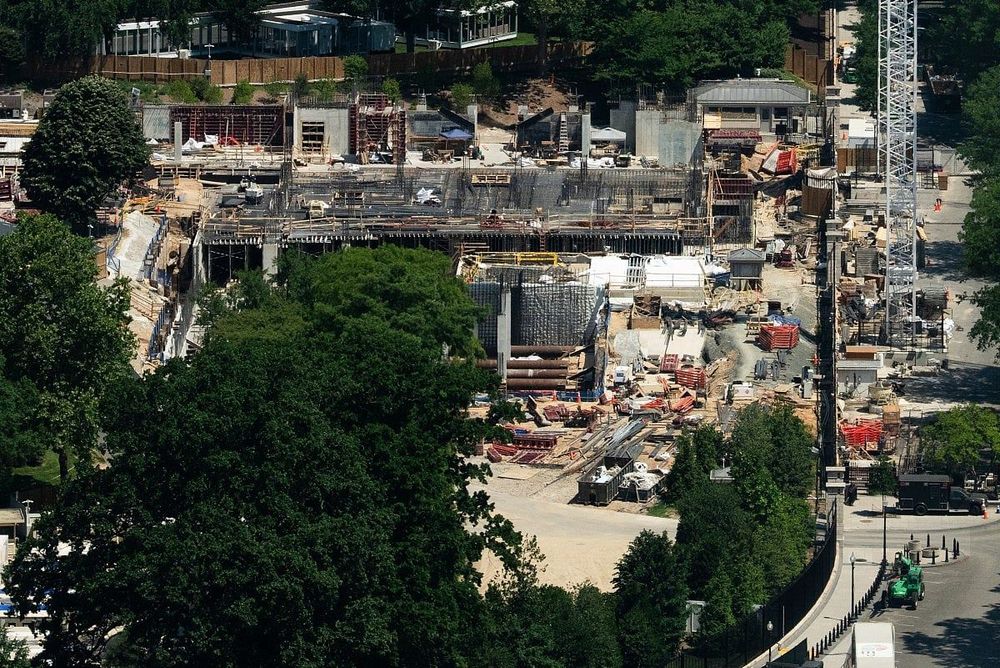
Photos from the construction site show significant progress on a basement complex, with some concrete walls rising above ground level. The ballroom is designed to seat 650 guests according to official White House specifications, more than triple the East Room's capacity of approximately 200 people. Currently, the White House State Dining Room seats approximately 140 guests, forcing presidents to use temporary outdoor tents or off-site venues for larger state dinners.
Costs and financing questions
Trump has insisted the ballroom will be privately financed, but media reports in June revealed that significant taxpayer funds were being directed to the project. While the White House initially cited a $200 million price tag, it quickly doubled the estimate to $400 million. The total cost could reach as much as $600 million.
Despite the legal challenges, the National Capital Planning Commission approved the final project design in an 8-1 vote on April 2, 2026.
Under the district court's original order, work was permitted to continue only on limited structures, including those underground. The ballroom construction is one of several Trump projects aimed at reshaping Washington by the time he leaves office in 2029, including renovations to the Lincoln Memorial Reflecting Pool and construction of a large arch. The ballroom case would be the first of these projects to reach the Supreme Court.